Dubai has never expanded randomly. Every major wave of growth – from Sheikh Zayed Road to Dubai Marina – has been anchored by infrastructure, connectivity, and long-term planning. The city's next chapter follows the same blueprint, but on a larger and more integrated scale.
Today, Dubai's emerging growth corridors are no longer simple stretches of land awaiting development. They are becoming complete urban ecosystems where transport, employment, housing, technology, education, and lifestyle converge. As the emirate advances toward the Dubai 2040 Urban Master Plan, the next generation of growth corridors will redefine where people live, work, invest, and build businesses.
Today, Dubai's emerging growth corridors are no longer simple stretches of land awaiting development. They are becoming complete urban ecosystems where transport, employment, housing, technology, education, and lifestyle converge. As the emirate advances toward the Dubai 2040 Urban Master Plan, the next generation of growth corridors will redefine where people live, work, invest, and build businesses.
Infrastructure as the Primary Catalyst
Historically, roads followed development. In modern Dubai, infrastructure increasingly precedes it.
Major transport investments like the Dubai Metro Blue Line, new strategic road corridors, and expanded transport networks are designed to unlock entirely new urban districts while improving connectivity across existing communities. The Blue Line alone is expected to serve around one million residents across nine districts, reinforcing transit-oriented development as a key planning principle.
Road projects are evolving in parallel. The recently announced Latifa bint Hamdan Corridor will create a major east-west connection linking Sheikh Zayed Road, Al Khail Road, Sheikh Mohammed bin Zayed Road, and Emirates Road, significantly increasing network capacity while supporting new residential and commercial districts.
Rather than solving the current congestion alone, these investments are preparing the city for decades of population and economic growth.
Major transport investments like the Dubai Metro Blue Line, new strategic road corridors, and expanded transport networks are designed to unlock entirely new urban districts while improving connectivity across existing communities. The Blue Line alone is expected to serve around one million residents across nine districts, reinforcing transit-oriented development as a key planning principle.
Road projects are evolving in parallel. The recently announced Latifa bint Hamdan Corridor will create a major east-west connection linking Sheikh Zayed Road, Al Khail Road, Sheikh Mohammed bin Zayed Road, and Emirates Road, significantly increasing network capacity while supporting new residential and commercial districts.
Rather than solving the current congestion alone, these investments are preparing the city for decades of population and economic growth.
Dubai South: From Vision to Metropolitan Centre
Few districts better illustrate Dubai's long-term strategy than Dubai South.
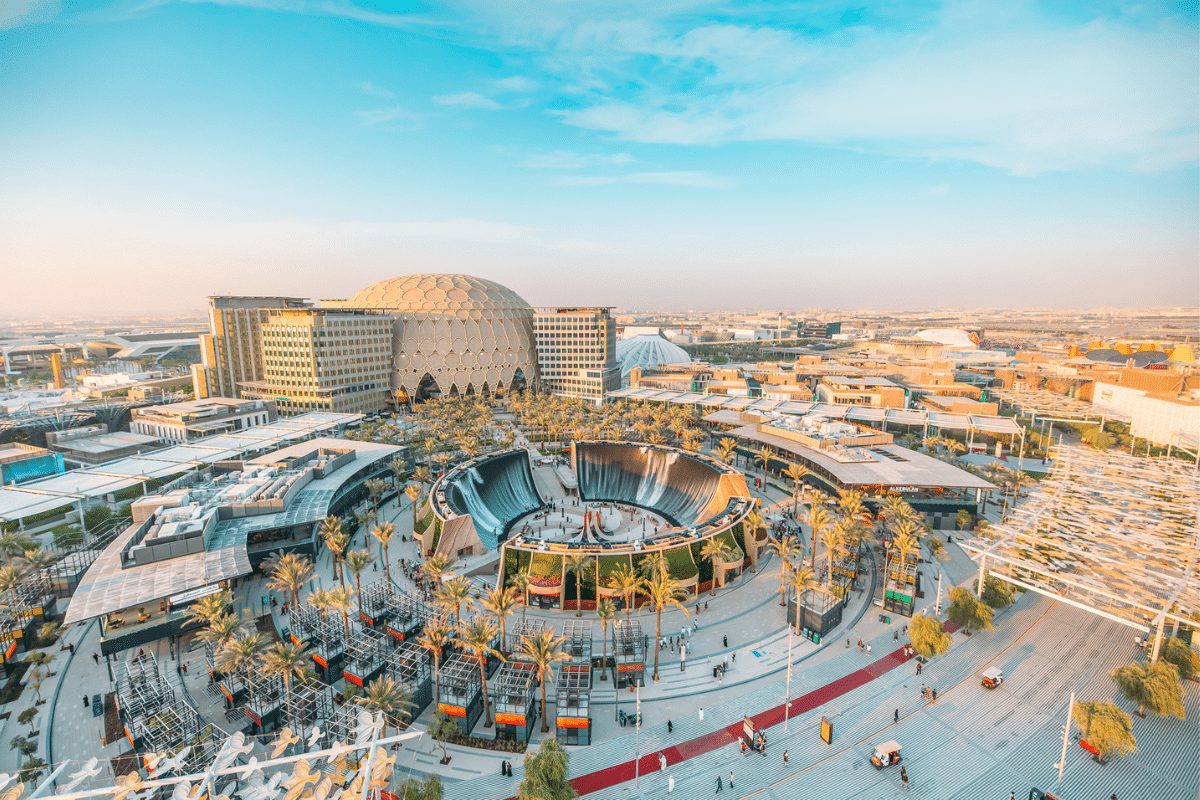
Originally conceived around Al Maktoum International Airport and Expo 2020, the area is rapidly transforming into a mixed-use city supported by logistics, aviation, advanced manufacturing, residential communities, and commercial development.
The expansion of Al Maktoum International Airport, combined with future regional rail connectivity and ongoing development at Expo City Dubai, positions the southern corridor as one of the emirate's most strategically important economic zones over the coming decades.
As employment opportunities continue to diversify, residential demand is expected to mature alongside them, creating a more balanced live-work environment than earlier suburban expansion models.
Originally conceived around Al Maktoum International Airport and Expo 2020, the area is rapidly transforming into a mixed-use city supported by logistics, aviation, advanced manufacturing, residential communities, and commercial development.
The expansion of Al Maktoum International Airport, combined with future regional rail connectivity and ongoing development at Expo City Dubai, positions the southern corridor as one of the emirate's most strategically important economic zones over the coming decades.
As employment opportunities continue to diversify, residential demand is expected to mature alongside them, creating a more balanced live-work environment than earlier suburban expansion models.
The Western Corridor & Dubailand's Evolution
For years, Dubailand represented opportunity more than reality. That perception is changing.
Areas including Dubai Hills, Al Barari, Majan, City of Arabia, Global Village, and surrounding master-planned communities are increasingly connected through upgraded road infrastructure and future transit investment.
The western corridor is evolving into a diverse residential market that accommodates families, professionals, and investors across multiple price segments. Rather than depending on a single landmark development, the area benefits from a network of complementary communities, schools, healthcare facilities, retail destinations, and leisure attractions.
As transport accessibility improves, these districts are likely to experience stronger integration with Dubai's traditional business centres.
Areas including Dubai Hills, Al Barari, Majan, City of Arabia, Global Village, and surrounding master-planned communities are increasingly connected through upgraded road infrastructure and future transit investment.
The western corridor is evolving into a diverse residential market that accommodates families, professionals, and investors across multiple price segments. Rather than depending on a single landmark development, the area benefits from a network of complementary communities, schools, healthcare facilities, retail destinations, and leisure attractions.
As transport accessibility improves, these districts are likely to experience stronger integration with Dubai's traditional business centres.
The Financial Expansion Corridor
Growth is also occurring vertically.
Dubai International Financial Centre's planned expansion through the Zabeel District reflects the city's ambition to strengthen its position as a leading global financial hub. The project will significantly increase office capacity while introducing residential, hospitality, retail, cultural, and public spaces integrated with next-generation mobility systems.
Rather than functioning as a standalone financial district, this expansion creates an extended central business corridor stretching toward Downtown Dubai and adjacent mixed-use developments.
Dubai International Financial Centre's planned expansion through the Zabeel District reflects the city's ambition to strengthen its position as a leading global financial hub. The project will significantly increase office capacity while introducing residential, hospitality, retail, cultural, and public spaces integrated with next-generation mobility systems.
Rather than functioning as a standalone financial district, this expansion creates an extended central business corridor stretching toward Downtown Dubai and adjacent mixed-use developments.
Transport-oriented Communities Become the New Standard
One of the defining characteristics of Dubai's next growth cycle is the increasing relationship between transport infrastructure and real estate.
Internationally, cities have demonstrated that high-quality public transport shapes long-term residential demand, commercial activity, and investment patterns. Dubai is embracing this model through metro expansion, integrated mobility planning, and road upgrades that encourage more connected communities.
Emerging districts are increasingly being designed around accessibility rather than simply available land, reducing travel times while supporting higher-density mixed-use development. Industry analysis suggests connectivity will become an even stronger driver of property demand as new metro corridors come online.
Internationally, cities have demonstrated that high-quality public transport shapes long-term residential demand, commercial activity, and investment patterns. Dubai is embracing this model through metro expansion, integrated mobility planning, and road upgrades that encourage more connected communities.
Emerging districts are increasingly being designed around accessibility rather than simply available land, reducing travel times while supporting higher-density mixed-use development. Industry analysis suggests connectivity will become an even stronger driver of property demand as new metro corridors come online.
Beyond Housing: Complete Urban Ecosystems
Perhaps the greatest difference between today's growth corridors and those of previous decades is their level of integration.
Modern master-planned communities increasingly combine residential neighbourhoods with schools, healthcare, offices, retail, hospitality, parks, entertainment, and digital infrastructure from the outset.
This reflects changing expectations among residents, who increasingly prioritise convenience, walkability, sustainability, and quality of life alongside property ownership.
Developments completing in 2026 demonstrate this shift, with strong emphasis on mixed-use environments, waterfront destinations, family-oriented communities, and sustainable urban planning aligned with the Dubai 2040 vision.
Modern master-planned communities increasingly combine residential neighbourhoods with schools, healthcare, offices, retail, hospitality, parks, entertainment, and digital infrastructure from the outset.
This reflects changing expectations among residents, who increasingly prioritise convenience, walkability, sustainability, and quality of life alongside property ownership.
Developments completing in 2026 demonstrate this shift, with strong emphasis on mixed-use environments, waterfront destinations, family-oriented communities, and sustainable urban planning aligned with the Dubai 2040 vision.
A More Polycentric Dubai
Rather than expanding around a single city centre, Dubai is steadily becoming a polycentric metropolis.
Downtown Dubai and DIFC remain global commercial anchors, while Dubai Marina continues to serve as a major residential and tourism hub. At the same time, Dubai South, Expo City, Dubailand, the western growth corridor, and emerging mixed-use districts are developing into self-sustaining centres of employment and lifestyle.
This distributed urban model reduces pressure on existing infrastructure while creating multiple destinations for investment, innovation, and economic activity.
Dubai's next generation of growth corridors is defined less by geography than by connectivity.
The city's future will be shaped by how effectively infrastructure, technology, mobility, sustainability, and mixed-use development work together to create resilient urban environments.
For investors, developers, businesses, and residents alike, the opportunity lies not simply in identifying the next location on the map, but in recognising the corridors where transport, employment, and community development intersect.
As Dubai continues its evolution toward 2040, these emerging corridors are poised to become the foundation of the city's next era of growth—one built on integrated planning, diversified economic activity, and globally competitive urban design.
Downtown Dubai and DIFC remain global commercial anchors, while Dubai Marina continues to serve as a major residential and tourism hub. At the same time, Dubai South, Expo City, Dubailand, the western growth corridor, and emerging mixed-use districts are developing into self-sustaining centres of employment and lifestyle.
This distributed urban model reduces pressure on existing infrastructure while creating multiple destinations for investment, innovation, and economic activity.
Dubai's next generation of growth corridors is defined less by geography than by connectivity.
The city's future will be shaped by how effectively infrastructure, technology, mobility, sustainability, and mixed-use development work together to create resilient urban environments.
For investors, developers, businesses, and residents alike, the opportunity lies not simply in identifying the next location on the map, but in recognising the corridors where transport, employment, and community development intersect.
As Dubai continues its evolution toward 2040, these emerging corridors are poised to become the foundation of the city's next era of growth—one built on integrated planning, diversified economic activity, and globally competitive urban design.